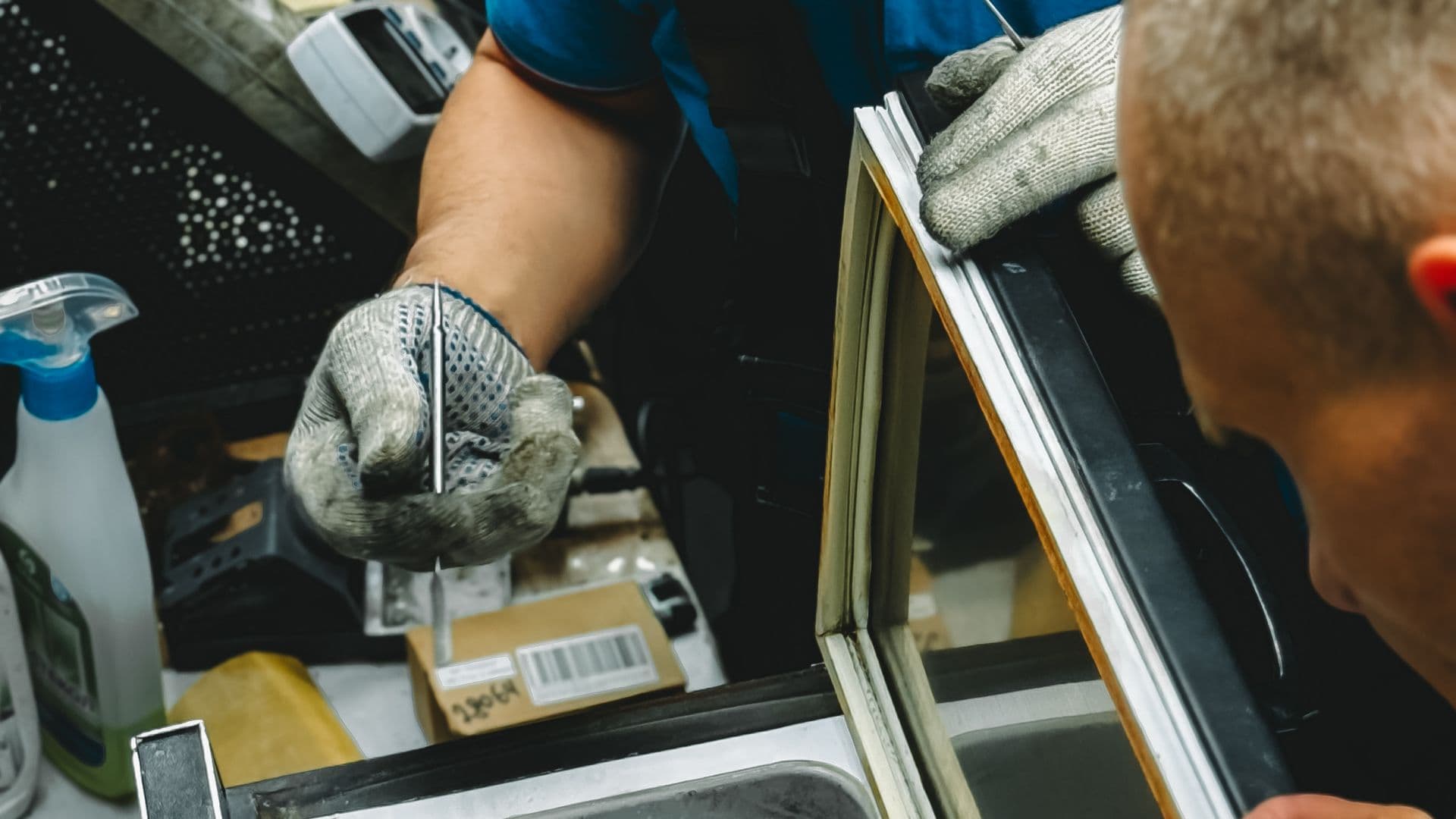
A homeowner calls. Their fridge stopped cooling. Whoever picks up writes down a name and an address, books the slot, and moves on. Your tech rolls the next morning, opens the door, and finds a 12-year-old builder-grade unit where the repair costs more than the homeowner will pay. He didn't carry the part anyway, because nobody asked the model.
That's a dead truck roll. You paid for the van, the fuel, the hour, and the labor, and you booked nothing.
The whole appliance repair business turns on one decision made before the truck leaves the lot: is this job worth rolling for, and if it is, what part do we carry? Both answers live in the same four pieces of information. Brand, model, symptom, and age. Miss any one of them at intake and the tech is guessing.
A single truck roll costs a company anywhere from $150 to over $1,000 once you load in labor, the vehicle, fuel, and overhead, with the fully loaded cost clearing $800 to $1,000 a visit. That's the price of being wrong about whether to send the truck. We hear the same gap on Vantal test calls: most shops capture a name and a symptom, then stop, which leaves the most expensive decision of the day to a hunch.
A quarter of your truck rolls didn't need to happen
The waste isn't a rounding error. TechSee's field-service data puts roughly 25% of truck rolls in the non-value-added bucket: no-fault-found, remotely diagnosable, or a part the tech didn't bring. The same research finds 25% of service calls need at least one follow-up visit.
Stack those and the picture gets ugly. One in four trucks you send shouldn't have gone, and one in four of the rest has to go back. Both failures are intake failures. The avoidable roll happens because nobody screened the job. The follow-up happens because nobody captured the model, so the tech showed up without the part.
TechSee, How To Reduce Truck Rolls In Field Service. Roughly a quarter of dispatches add no value and a quarter of calls require a return trip. The 'clean first visit' bar is what better intake protects.
The reason this matters more in appliance repair than in most trades is that the math flips on the brand. A high-end unit is almost always worth the roll. A cheap unit past its prime usually isn't, and the homeowner is going to replace it anyway once you quote the repair. You can't tell which call is which without the brand and the model, and you can't carry the right part without them either.
Why the brand and model decide the whole job
Here's the part most shops skip at intake, and it's the part that pays. Yale Appliance's analysis of 6,700+ real service calls lays out exactly how much the unit decides the economics.
Their dispatch fee is $119.95 just to get a tech to the door. Refrigeration repairs average $255.40, and run past $900 on the high end. A Sub-Zero compressor replacement in their example lands at $900 plus dispatch, $1,019.95 all in. That is a job worth rolling a truck for, carrying the part, and doing once.
Now run the same call on a builder-grade fridge. Yale's rule of thumb: if a repair is 33% or more of a new appliance's cost, replacement is the smarter move. A $255 repair on a unit you can replace for $600 is a job the homeowner walks away from. This Old House pegs refrigerators as the most-repaired appliance at ~54% of homeowners surveyed, so this exact decision shows up on your line constantly.
| Intake fact | Premium unit (Sub-Zero) | Builder-grade unit | What it tells dispatch |
|---|---|---|---|
Symptom | Not cooling | Not cooling | Same symptom, different job |
Likely repair | Compressor, $1,019.95 | Compressor, near new-unit cost | Brand sets the price |
Repair vs replace | Repair | Replace | 33% rule decides |
Worth the truck | ✓ | Often no | Screen before you roll |
Carry the part? | Yes, model-specific | n/a | Model decides the van load |
Repair figures from [Yale Appliance, 6,700+ customer-pay service calls, Jan to Aug 2025](https://blog.yaleappliance.com/what-should-you-pay-for-an-appliance-service-call). The 33%-of-new-cost replace rule is theirs. The decision column is the call your intake makes before the truck moves.
The symptom is identical. Not cooling. The decision is opposite, and the only thing that flips it is the brand and the model. An intake that captures "fridge not cooling" and stops has thrown away the one fact that tells you whether to send anyone at all.
What a four-fact intake actually sounds like
You don't need a long script. You need four facts, in order, every call: brand, model, symptom, age. The model number is on a sticker inside the door, behind the kick plate, or on the back. A good intake walks the homeowner to it instead of guessing.
Scenario: Homeowner calls Brightline Appliance Repair on a Tuesday afternoon. Their refrigerator stopped cooling. The intake captures brand, model, symptom, and age before booking, so dispatch knows whether to roll and what part to carry.
This is a voice call, shown here as a chat for readability. Synthesized from a real Vantal call. Names changed. The greeting uses a human name and never mentions AI.
That intake did three jobs at once. It confirmed a premium brand worth rolling for, it pulled the model number so the tech carries the part, and it logged the age so nobody quotes a repair on a unit the homeowner should replace. The symptom alone would have done none of that.
The first-time fix number that pays for the whole change
Here is the lever. Appliance Marketing Pros reports best-in-class shops hit 85 to 90% first-time fix against an industry average of about 75%, and each avoided repeat visit saves $200 to $300. The broader field-service benchmark agrees: Comparesoft puts the average first-time fix rate around 80%, with high achievers near 90%.
First-time fix is mostly an intake outcome. The tech can't fix it on the first visit if he showed up without the part, and he showed up without the part because nobody captured the model. Closing the gap from 75% to 90% is fifteen points of jobs you finish on the first roll instead of the second.
Appliance Marketing Pros, Appliance Repair KPIs: ~75% industry-average first-time fix versus 85 to 90% best-in-class, with each avoided repeat saving $200 to $300. Comparesoft corroborates the ~80% field-service average and ~90% high-achiever mark. The gap is mostly whether the tech rolled with the right part.
Run it against your own numbers. A truck that finishes the job on the first visit does the next job sooner, so first-time fix is the lever that decides how many calls a tech clears in a day. The calculator below is built for the dispatch-fee economics in this trade.
Move the sliders to your own shop's numbers. Output assumes a tighter intake recovers the avoidable rolls and repeat visits you currently eat.
Revenue you're leaving on the line, per year
$26,520
Assumes a 50% close rate on the calls that get answered. Actual recovery depends on triage rules and your on-call rotation.
See it on your lineThis is a real industry, not a rounding error in someone's budget. This Old House sizes U.S. appliance repair at $6.5 billion in 2024, and Bozmanfix reports it reached $7.0 billion in 2025. The shops winning share inside that number aren't the ones with more trucks. They're the ones whose trucks finish the job the first time.
The replace-not-repair wall, and why age belongs at intake
The fourth fact, age, is the one shops skip most and regret most. Bozmanfix reports 58% of consumers replace rather than repair when a major appliance breaks, and only 36% of large appliances get repaired versus 58% replaced. That's not a marketing problem you can outrun. It's the homeowner doing the same 33%-rule math Yale describes.
If you don't capture age and brand at intake, you find this out the expensive way. The tech rolls, quotes the repair, and the homeowner replaces the unit instead. You ate the dispatch and booked nothing. This Old House notes service fees mostly run $75 to $125 a visit and homeowner dissatisfaction climbs sharply above $150, so you can't simply price the dead roll back, either.
The shops that stopped booking anything without a model number say the same thing once they've run it for a quarter. Half the jobs they used to roll on cheap units were headed for replacement no matter what the tech found. Capture the brand, model, and age on the phone, have the honest conversation there, and the trucks only go where the work actually is.
Capturing age on the phone lets you have that conversation before the truck moves. Premium unit, reasonable age: roll, repair, full ticket. Cheap unit past its prime: tell them straight, save the roll, and keep the goodwill for when they need the new one installed.
What to do tomorrow
Four moves, none of which need a developer or a new system.
- Rewrite your intake to four facts. Brand, model, symptom, age, in that order, every call. One page. Hand it to whoever answers the phone tonight.
- Teach the model-number hunt. Inside the door, behind the kick plate, on the back. The person on the phone walks the homeowner to the sticker instead of booking blind.
- Set your roll-or-not rule. Write the brands and ages you'll always roll for, and the ones you screen with the 33% rule before sending a truck.
- Pull last month's repeat visits. Count how many were a missing part. That's your first-time-fix leak, and it traces straight back to intake.
Hear Vantal capture brand, model, and age on your line
Vantal is the AI intake that runs your four-fact script on every call. It captures the brand, model, symptom, and age, applies your roll-or-not rule, books the job into your calendar, and writes the model number into the work order so the tech rolls with the part. English and Spanish on the first ring, every call recorded and transcribed.
Against the human alternative, a bilingual receptionist runs about $18 an hour base (Indeed), which lands near $4,000 to $6,000 a month fully loaded once you cover nights and benefits, and still misses calls overnight. If you want to hear how a tight intake sounds on your own number, run a test call on your line. It takes 30 seconds and we email you the recording and the transcript. Or book a 20-minute demo and we'll wire it to your roll-or-not rules.
FAQ
What information should an appliance repair intake capture before booking?
How much does a wasted truck roll actually cost an appliance shop?
Why does the appliance brand change whether you send a tech?
Does capturing the model number really improve first-time fix?
What does an AI receptionist cost for an appliance repair shop?
Keep reading
A burst pipe at 11pm: what good emergency intake actually sounds like
A real-sounding after-hours emergency plumbing call, broken down line by line. The triage questions, the transfer-or-book decision, the confirmation text, and why each move keeps the job on your truck instead of someone else's.
What an AI receptionist costs a plumbing shop in 2026 (and what voicemail costs you)
Four ways to answer your plumbing line: voicemail, a human receptionist, an answering service, or an AI receptionist. The real cost ranges for each, and why the free option is the most expensive once you count the jobs it leaks.
Answering service vs virtual receptionist vs AI: which one your HVAC shop actually needs
Three ways to stop sending HVAC calls to voicemail: a per-minute answering service, a dedicated virtual receptionist, or an AI receptionist. Honest cost ranges and a head-to-head on when each one is the right call.