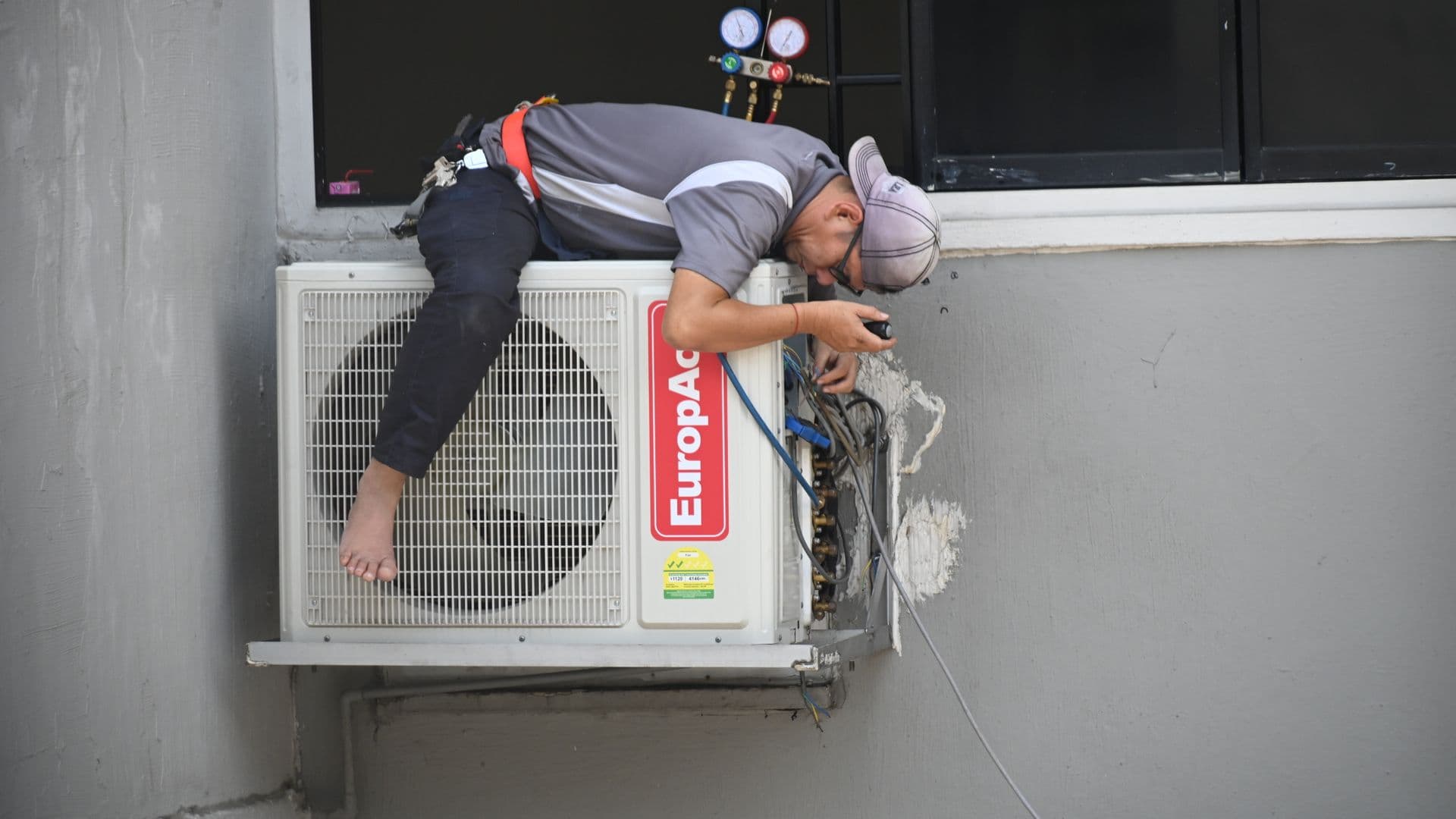
It's late June. The first real heat wave is coming, and you already know how the next eight weeks go. The phone doubles. Your techs are booked three days out. The front desk is drowning, and the calls you can't get to roll straight to whoever picks up next.
The numbers on a heat wave are not subtle. Samsara analyzed 65 million HVAC service trips and found that during the June 2025 heat wave, Maine technicians ran 374% more trips per truck than the same month a year before. That's 45 extra trips and 758 extra miles per vehicle, in one state, in one heat event. Demand like that does not call ahead.
So here's the question that decides your summer: when the spike hits and you physically cannot answer every call, where does the overflow go? Right now the answer is "your competitor." This playbook changes the answer to "booked, into your calendar, by a tier that costs you nothing in October."
A heat wave doubles your calls overnight, and you can't staff for it
The first instinct is to throw bodies at it. Almost nobody actually does. In a ServiceTitan survey run with the ACCA, 65% of HVAC companies just have their existing team work longer hours during peak season. Only 20% add staff. 15% change nothing at all. Among large shops with 20-plus techs, 80% lean on overtime and only 20% add headcount.
The reason isn't laziness. It's that a seasonal hire is a bad trade. You spend July recruiting and training someone, they're useful for about eight weeks, and then you're carrying a salary into October when the cooling calls dry up. The math only works if the spike is a clean, predictable hump you can staff to. It isn't.
Illustrative season shape, not a single shop's volume. Samsara's analysis of 65M HVAC service trips documented the heat-wave trip surge; the cooling-then-heating ramp across the year is the trade's well-known seasonality. Index relative to a winter baseline of 100.
So the crew grinds overtime, and the front desk eats a call volume it was never sized for. The calls don't wait politely in a queue. They go to voicemail, or they ring out, and the homeowner with no AC at 4pm dials the next listing.
A quarter of your calls already go unanswered, before the spike
Here's the part that should bother you. The overflow problem isn't new in July. It's just worse in July.
Even in a normal month, Invoca's platform data shows 27% of calls to home-services businesses go unanswered. More than a quarter. And the safety net you think you have, voicemail, catches almost nothing: under 3% of callers pushed to voicemail leave a message. We see the same on Vantal test calls. A homeowner who hits a recording at 4pm in a heat wave does not leave a name and number. They hang up and tap the next result.
Now take that baseline miss rate and multiply it by a 2x or 3x summer spike. The same front desk, the same number of hands, double the inbound. The overflow isn't a rounding error. It's a large and growing share of your best calls.
| A normal day | July heat wave | With an AI overflow tier | |
|---|---|---|---|
Inbound calls | 40 | 100 | 100 |
Answered live | 29 | 58 | 98 |
Sent to voicemail or ring-out | 11 | 42 | 2 |
Voicemails that leave a message | under 1 | 1 | n/a |
Overflow recovered | ✗ | ✗ | ✓ |
Illustrative, anchored to [Invoca's 27%-unanswered and sub-3%-voicemail home-services figures](https://www.invoca.com/blog/how-much-missed-sales-calls-cost-home-services-businesses). The point is directional: a fixed answering capacity catches a smaller and smaller share as volume climbs, and voicemail recovers almost none of the gap.
What one dropped call in July actually costs you
A missed call in summer isn't a missed call. It's a missed install. The 4pm no-cool in a heat wave is the homeowner who will pay full ticket, today, to whoever can come out. They are not comparison-shopping a tune-up.
Invoca's home-services analysis puts the average loss at $1,200 per missed call. And it compounds. The homeowner who can't get through doesn't just cost you this job. They call the next shop, and the relationship, plus their next few jobs, goes with them.
Set the sliders to your shop in a peak week. Bump the missed-calls number up for a heat wave week, not an average week. Output assumes Vantal would have answered the overflow you currently lose.
Revenue you’re leaving on the line, per year
$249,600
Assumes a 50% close rate on the calls that get answered. Actual recovery depends on triage rules and your on-call rotation.
See it on your shop's lineThe ugly version of this math: you already paid Google to make that phone ring. You paid for the truck wrap, the reviews, the years of being the name people remember. The call lands, and you're not there to answer it. Every input is paid for except the one that closes the job.
The 3-question triage script that books the spike in 90 seconds
You can't add hands fast enough for a heat wave, but you can make every hand faster. The lever is triage discipline. A tech or a friendly receptionist wants to be helpful, so they start diagnosing on the phone, and four minutes later they still haven't booked anyone. During a spike, that's how a 40-call day becomes a 20-booking day.
The fix is the same three questions, in the same order, every call.
First, what's the symptom? No cold air, no air at all, a strange noise, or a smell. The answer routes the call.
Then, when did it start? Today routes differently than two weeks ago. A 4pm-today no-cool with a baby upstairs is the call you drop everything for. A two-week intermittent rattle is a paid diagnostic, booked for whenever you have a slot.
Last, the address. You need it before you can offer a window, because in a heat wave your drive times blow out and distance is the silent killer of an accurate schedule.
Scenario: Homeowner calls Comfort Air at 4:12pm on a 104-degree July Tuesday. The front desk is buried. AC is blowing warm. Vantal answers the overflow and runs the 3-question triage.
Synthesized from a real Vantal voice call, visualized as a chat for readability. Names changed. Booked in 84 seconds while the human front desk was on another line.
The overflow tier that vanishes in October: AI intake, not a seasonal hire
Here's the structure that actually absorbs the spike: three tiers, and only one of them is new.
Tier 1 is your front desk, same as today. It answers what it can, runs the triage script, and books the easy ones live.
Tier 2 is overflow intake, and this is the new piece. When tier 1 is on another line or past capacity, the call rolls to an AI intake agent instead of voicemail. It runs the exact same three-question script, books non-emergencies straight into your calendar, and warm-transfers true emergencies. It answers call number one and call number fifty-one identically. It scales to the heat wave and back down to nothing, so you pay for the spike, not for a body sitting idle in October.
Tier 3 is your on-call tech, for the warm-transferred emergencies. It rotates weekly, paid for the rotation.
The routing is a one-time afternoon of work with your phone provider. Most shops are on a hosted phone system or a softphone bundled with their FSM, and all of them support overflow and time-of-day routing.
Time-of-day routing is supported by every modern softphone (RingCentral, Vonage, Housecall Pro, ServiceTitan, Jobber). One afternoon to set up.
| Capability | Voicemail | Seasonal hire | AI overflow tier (Vantal) |
|---|---|---|---|
Answers the spike overflow | ✗ | ✓ | ✓ |
Live the day you need it | n/a | After hiring + training | Same day |
Scales down for free in October | ✓ | ✗ | ✓ |
Runs your triage script every time | ✗ | After training | ✓ |
Answers call #51 like call #1 | ✗ | ✗ | ✓ |
Warm-transfers true emergencies | ✗ | ✓ | ✓ |
Spanish on the first ring | ✗ | Sometimes | ✓ |
Recording and transcript every call | ✗ | Rarely | ✓ |
Capability and economics comparison. The seasonal-hire column reflects a typical bilingual full-staff CSR cost during peak. AI intake pricing depends on call volume and integrations.
The seasonal hire is the thing you can finally stop doing. The spike is real, but the headcount doesn't have to be. An overflow tier that turns on for the heat wave and turns off when the calls do gets you the answered-call rate of a big shop without the October payroll.
2 things this playbook won't fix on its own
This isn't a way to magically take more jobs than your trucks can run. If your techs are already three days out, a faster intake just books unhappy customers further out. Fix your throughput and your scheduling realism first, then turn the overflow tier on so the bookings you take are ones you can actually keep.
And the AI tier doesn't decide what counts as an emergency. You do. You write the rules in plain English (4pm no-cool with kids in the house, gas smell, water on the floor), and the agent enforces them consistently at the busiest hour of the worst day. It's discipline at scale, not judgment you've handed off.
What to do tomorrow
Four moves, less than a day, no developer.
- Pull last July's call log. Count the calls that hit voicemail or rang out during your peak weeks. Multiply by $1,200. That's the overflow you're about to lose again.
- Write your 3-question triage script. Symptom, when it started, address. One page. Hand it to everyone who answers a phone this summer.
- Set up overflow routing with your phone provider. Roll the second-and-beyond calls to anything that isn't voicemail.
- Run a test call on your own line. Call during what would be a busy hour and listen for the moment you'd hang up as a homeowner with no AC. Fix that before the heat wave does it for you.
Hear Vantal answer your overflow in 30 seconds
Vantal is the overflow tier that turns on for the spike and off in October. It picks up the call your front desk can't get to, runs your triage rules, books into your calendar, and warm-transfers true emergencies to your on-call cell. English and Spanish on the first ring, every call recorded and transcribed.
If you want to hear what it'd sound like on your own shop's line, run the test on your line. It takes 30 seconds and we email you the recording and the transcript. Or book a 20-minute demo and we'll wire it to your phone tree before the next heat wave.
FAQ
How much does HVAC call volume go up in a heat wave?
Should I hire seasonal staff for the summer HVAC rush?
What happens to the calls my shop misses during peak season?
Can an AI intake tier really handle a heat-wave spike?
What does the 3-question triage actually ask?
Keep reading
Answering service vs virtual receptionist vs AI: which one your HVAC shop actually needs
Three ways to stop sending HVAC calls to voicemail: a per-minute answering service, a dedicated virtual receptionist, or an AI receptionist. Honest cost ranges and a head-to-head on when each one is the right call.
If you call an HVAC lead back in 90 seconds, you close it. If you wait until tomorrow, you don't.
Speed-to-lead is the single highest-leverage operations change an HVAC contractor can make this year. The math, the script, and the phone tree that makes it possible.
Criminal defense intake happens at night: answer before the next lawyer does
Arrest calls, DUI calls, bond questions, and family-member panic do not wait for business hours. Criminal defense firms need a live intake line that captures urgency and books the consult without giving legal advice.