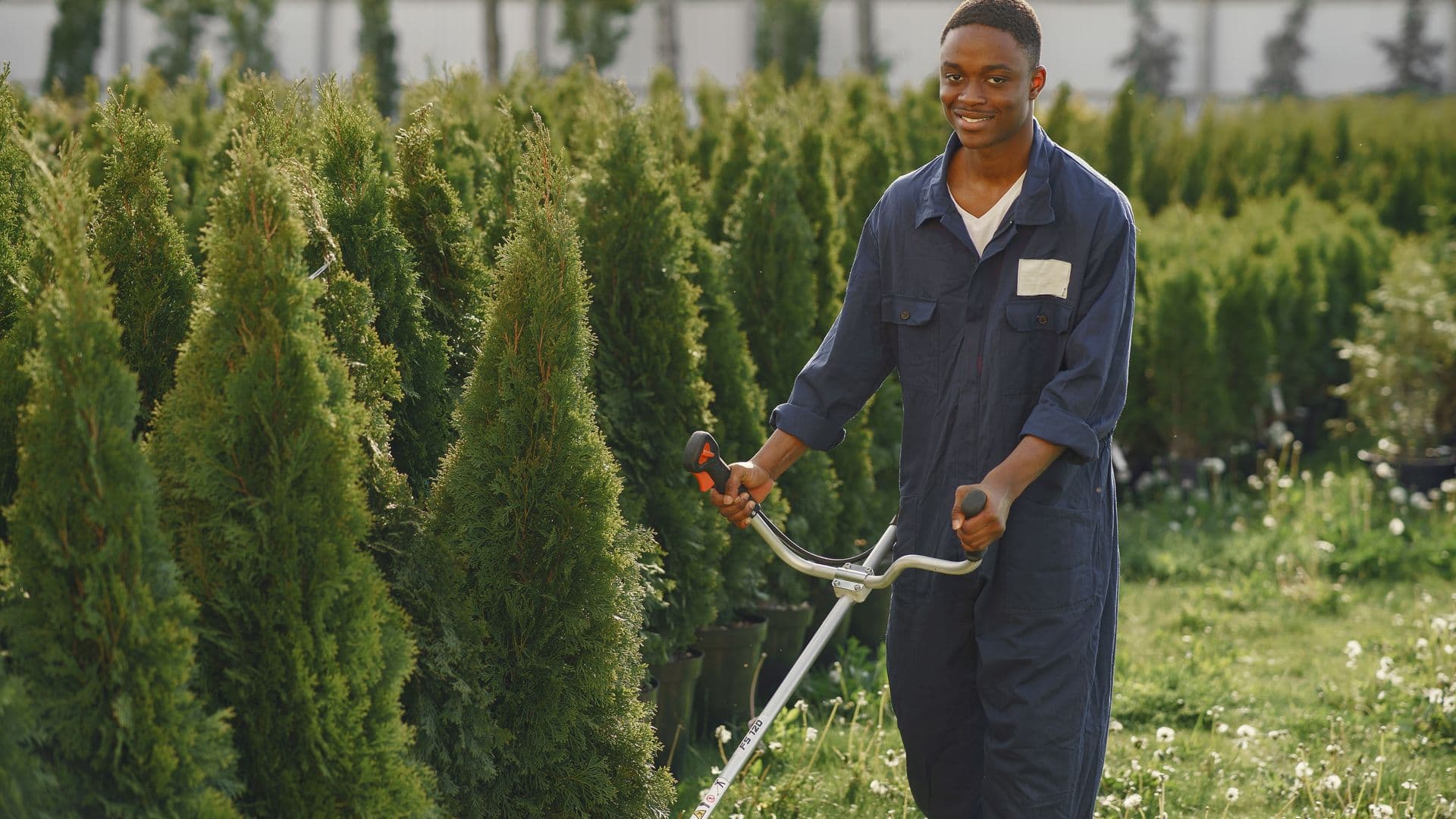
Your phone rings at 7am on the first warm Saturday in March. You are on your knees strapping a mower to the trailer, gloves on, truck running. You let it ring. By the time you check the missed call at noon, that homeowner has already booked the crew that answered.
That was not a $90 mow. That was the whole season. A residential lawn account runs roughly $1,300 to $3,400 from spring green-up to the last fall cleanup, and you forfeited the entire thing because you had your hands full at 7am.
This post is about three things: why the spring window is the only window that matters, what one missed March call actually costs you across the season, and the one change that gets a live voice on your line while your crews are in the field.
Spring is the only window, and it slams shut in six weeks
Landscaping is not a steady business with twelve even months. Aspire's industry data shows northern and northeastern demand peaks in spring, summer, and early fall, then hits a significant slowdown in winter. The Midwest is the same shape, strong summer revenue and a scramble to diversify into snow removal once the season dies.
What that shape means for your phone is simple. The calls all arrive at once. Every homeowner in your zip code looks out at a brown lawn on the same first warm weekend and reaches for the same phone. The crews that book those weeks book the year. The crews that miss them spend the summer underwater.
Seasonal demand shape from Aspire's landscaping industry statistics (citing Mordor Intelligence): Northeast and Midwest demand peaks in spring and summer with a sharp winter slowdown. Bars are an illustrative demand shape, not a single company's call log.
The smart operators already know this. Procured's landscaping guidance tells crews to ramp ad and marketing spend 4 to 6 weeks ahead of spring demand, not after it has already arrived, and to use rebooking reminders to lock in spring contracts before competitors do. The booking window opens early. The crew that answers first locks the season.
A missed March call is four figures gone, not a $90 ticket
Here is the part most owners get wrong. They treat a missed call like a missed mow, a $90 hit they will make up next week. It is not a mow. It is a contract.
The average homeowner spends about $300 a month on landscaping services, per Angi data compiled by Jobber. A standard residential mow runs $45 to $90 a visit, and across a typical season of weekly visits those rates annualize to roughly $1,300 to $3,400 per account. That is per yard, every season, recurring.
So when the phone goes to voicemail at 7am in March, you did not lose a Saturday morning. You lost a customer who would have paid you every week until October, plus the fall cleanup, plus the renewal next spring, plus the neighbor they would have referred.
The voicemail does not save you either. Invoca's home-services call data shows 27% of calls go unanswered and under 3% of callers pushed to voicemail leave a message. We see the same on Vantal test calls: a homeowner who hits voicemail in March does not wait around. They tap back to the search results and dial the next crew on the list.
The first crew to call back wins 78% of the time
Speed is the entire contest in spring, and the research is brutal about how fast the window closes. The MIT lead-response study found that responding within 5 minutes makes you 21x more likely to qualify the lead than waiting 30 minutes. The same body of research found the first business to respond wins 78% of the time.
For a landscaper in the rush, the asymmetry is sharper than almost any trade. The homeowner is not deciding whether they want their lawn done. They decided that when they looked out the window. They are deciding who gets the contract, and that decision goes to whoever calls back while the brown grass is still bothering them.
MIT lead-response research (Dr. James Oldroyd) and HBR's 'The Short Life of Online Sales Leads,' via Casey Response: a 5-minute response is 21x more likely to qualify the lead than 30 minutes, lead quality drops 80% after the first 5 minutes, and 78% of customers buy from the first business to respond. Values illustrate that decay for a season-long contract decision.
This is why your crews physically cannot be the answer. A two-person crew is the industry standard, not an exception. Aspire's data (citing IBISWorld) puts the US landscaping market at $184.1 billion across 726,565 businesses with an average of two employees each. The whole industry is small, field-based crews. Both hands are on a mower during the exact hours the phone rings hardest. The phone losing to the work is structural, not a discipline problem you can fix by trying harder.
What one missed call a week costs you across a season
The cost of a missed call is not the call. It is the gross margin on a season-long contract you never got. A single residential account is worth four figures over the year, and the homeowner who could not reach you is paying that four figures to someone else right now.
Miss one $2,400 average contract a week during the eight-week rush and you are out nearly $19,000 in season revenue, before you count the renewals and referrals those accounts would have produced. Move the sliders to your own numbers.
Set the sliders to your own crew's numbers. Ticket here means the value of a season-long residential contract, not a single mow. The output assumes Vantal would have answered the calls you currently let ring out.
Revenue you're leaving on the line, per year
$249,600
Assumes a 50% close rate on the calls that get answered. Actual recovery depends on triage rules and your on-call rotation.
See it on your lineStack that against your options. A bilingual human receptionist runs $4,000 to $6,000 a month and still goes home at 5pm, right when homeowners get off work and start dialing. A voicemail recording loses you 97% of the callers who reach it. We built Vantal for the two-person crew that cannot afford a full-time front desk and cannot afford to keep handing the spring rush to whoever picked up.
| Capability | Voicemail | Human answering service | AI intake (Vantal) |
|---|---|---|---|
Picks up at 7am Saturday in March | ✗ | Sometimes | ✓ |
Answers while both hands are on a mower | ✗ | ✓ | ✓ |
Average pickup speed | n/a | 30 to 90 seconds | 3 rings |
Books the season contract to your calendar | ✗ | Sometimes | ✓ |
Captures the address and property size | ✗ | Sometimes | ✓ |
Spanish on the first ring | ✗ | Sometimes | ✓ |
Recording and transcript every call | ✗ | Rarely | ✓ |
Capability comparison only. Pricing varies; the human-service column reflects the bilingual full-staff range published by Indeed (US median, 2025). AI intake pricing depends on call volume.
What a 7am rush call sounds like when someone actually answers
You do not need a script for the friendly part. You need one for the part that books the contract before the homeowner hangs up and dials the next crew. Get the service, the property, and the address, then put them on the calendar.
Scenario: Homeowner calls Green Valley Lawn Care at 7:04am on the first warm Saturday in March. Crew is already loading the trailer. Vantal answers and books the season.
Synthesized from a real Vantal voice call, shown as a chat for readability. This is a voice call, not a text thread. Names changed. Booked a weekly contract in 81 seconds, no callback needed.
What to do this week before the rush hits
Four moves that take less than an afternoon. None of them need you to buy anything to start.
- Pull last spring's missed calls. Count them. Multiply by an average season contract value of $2,000 to $3,000. That number is what your phone cost you last year.
- Forward your line to anything that is not voicemail during field hours. Your cell, an answering service, or Vantal. Anything that does not open with "please leave a message."
- Write your three intake questions. Service scope, property size, address. One page, your own words, so whoever answers books the same way every time.
- Call your own line at 7am on a Saturday. Hear what a homeowner hears while you are loading the trailer. Fix the part you would hang up on.
Hear Vantal answer your line in 30 seconds
Vantal is the receptionist that picks up the 7am rush call while your crews are in the field. Three rings, scopes the season contract, captures the address and property size, and books the job into your calendar before the homeowner opens the next search tab. English and Spanish, every call recorded, every transcript in your inbox.
If you want to hear what it would sound like on your own line before the rush starts, run the test on your crew's number. No setup, no card.
FAQ
Why does a missed call in spring matter more than one in July?
How fast does a landscaper need to call back a spring lead?
How can a two-person crew answer the phone while mowing?
What does an AI receptionist cost for a landscaping crew?
Can it book a recurring season contract, not just a single visit?
Keep reading
A burst pipe at 11pm: what good emergency intake actually sounds like
A real-sounding after-hours emergency plumbing call, broken down line by line. The triage questions, the transfer-or-book decision, the confirmation text, and why each move keeps the job on your truck instead of someone else's.
What an AI receptionist costs a plumbing shop in 2026 (and what voicemail costs you)
Four ways to answer your plumbing line: voicemail, a human receptionist, an answering service, or an AI receptionist. The real cost ranges for each, and why the free option is the most expensive once you count the jobs it leaks.
Answering service vs virtual receptionist vs AI: which one your HVAC shop actually needs
Three ways to stop sending HVAC calls to voicemail: a per-minute answering service, a dedicated virtual receptionist, or an AI receptionist. Honest cost ranges and a head-to-head on when each one is the right call.