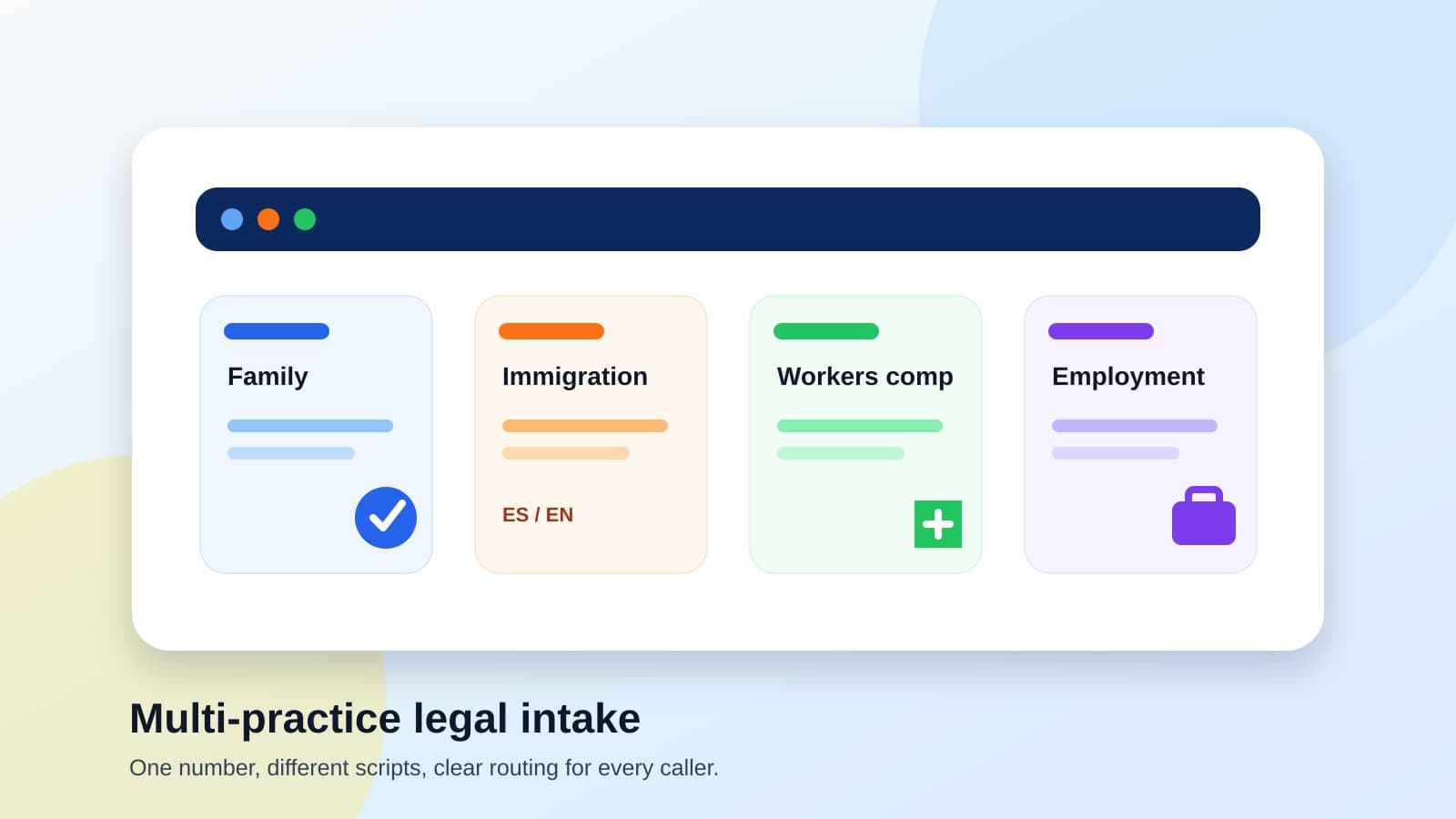
A law firm that handles personal injury and criminal defense often has another problem hiding in the phone log: everything else urgent.
A custody caller who needs a consultation before an exchange. A spouse who just received divorce papers. An immigration caller with a notice they do not understand. A worker who was hurt and is being pushed back to the job too early. An employee who was fired and thinks it was illegal.
These are not casual inquiries. They are legal problems with emotion, deadlines, and confusion attached.
The pattern is the same: answer, calm, qualify, book
Different practice areas need different questions, but the intake job is consistent:
- answer quickly,
- acknowledge the stress,
- identify the matter type,
- capture the deadline or risk,
- route to the right attorney,
- and book the consultation.
This is where one generic receptionist script breaks. A divorce caller and an immigration caller should not hear the same second question.
Build intake by practice area, not by phone number
A firm can use one public phone number and still run different intake logic under the hood.
| Practice area | Urgency signal | First-pass intake questions |
|---|---|---|
Family law | Custody exchange, protective order, served papers, hearing date | Are there children involved? Have you been served? Is there a court date or safety concern? |
Immigration | Notice, hearing, deadline, detention, work authorization | What type of notice did you receive? Is there a deadline? What language do you prefer? |
Workers comp | Recent injury, denied treatment, employer pressure | When were you injured? Have you reported it? Are you receiving medical care? |
Employment | Termination, unpaid wages, harassment, retaliation deadline | What happened at work? When did it happen? Are you still employed there? |
Estate/probate | Recent death, court deadline, family dispute | Has someone passed away? Is there a will? Has a probate case been opened? |
Each practice area needs its own first-pass facts. Intake should route and book, not advise.
The advantage of an AI intake line is that it can branch instantly. It does not forget the family-law script after spending all morning on PI calls.
Family law intake: empathy first, facts second
Family law calls often start messy. The caller may not know whether they need a divorce lawyer, custody lawyer, or protective-order attorney. They may just know that something changed and they need help.
The intake voice should ask:
- Are children involved?
- Has anyone been served with papers?
- Is there an upcoming court date?
- Is there a safety issue or protective order?
- What county is the matter in?
- Is there an existing case number?
Scenario: A parent calls after receiving custody papers. The intake voice captures deadline, county, children, and consult availability.
Example family-law intake. No legal advice is given; the caller is routed to a consultation.
Immigration intake: language and deadlines are the conversion lever
Immigration callers often have documents in front of them: a notice, a receipt, a hearing letter, a request for evidence, a work permit issue, or a family petition question.
A strong immigration intake line has to handle language preference immediately. If the caller needs Spanish and the firm makes them wait for someone to call back, the firm may lose the consult before anyone reviews the document.
Suggested immigration intake fields:
- preferred language,
- immigration matter type,
- document or notice received,
- deadline shown on the notice,
- current location,
- detention status if relevant,
- and best callback method.
Workers' comp and employment intake: dates decide urgency
For workers' comp and employment, the first pass is often about dates:
- When did the injury happen?
- When was it reported?
- When were you terminated?
- When did the harassment or retaliation happen?
- Is there a hearing, denial letter, or agency deadline?
A live intake line does not need to analyze the claim. It just needs to protect the lead from disappearing and get the facts into the attorney's review queue.
What to write for SEO this week
If today's content focus is law firms, the blog and landing-page cluster should look like this:
| Cluster | Primary keyword angle | Call-to-action angle |
|---|---|---|
Personal injury | car accident lawyer near me, truck accident attorney, slip and fall lawyer | Call now after an accident; free consult; do not wait for insurance |
Criminal defense | DUI lawyer open now, arrested in [city], bond hearing attorney | Someone answers 24/7; urgent arrest intake |
Family law | custody lawyer, divorce lawyer, protective order attorney | Book a consult before the hearing or deadline |
Immigration | immigration lawyer Spanish, USCIS notice help, deportation defense consult | Spanish intake on first ring; deadline captured |
Workers comp | workers comp lawyer, injured at work, denied workers comp claim | Report the injury details and book a review |
Build pages around the situations that make people pick up the phone now.
The content should not read like a legal textbook. It should read like the caller's situation:
- “You were served papers. Here is what happens next.”
- “Your spouse was arrested for DUI. Here is what the intake call needs to know.”
- “You received a USCIS notice. Do not let the deadline pass.”
- “You were injured at work and the employer says it is not covered.”
Then every page should drive to a live answer.
The operating checklist for a multi-practice firm
- One phone number can work. The caller can state the issue and the intake system branches.
- One script cannot. Each practice area needs its own qualifying questions.
- Every call needs a transcript. Attorneys should review a clean fact summary before the consult.
- Urgent rules must be explicit. Custody hearing tomorrow, detained immigration matter, in-custody criminal matter, or severe PI should not route like a routine consult.
- Every SEO CTA should match actual coverage. If the site says call now, someone needs to answer now.
Let Vantal route the legal intake call correctly
Vantal answers new-client calls 24/7, identifies the practice area, follows the right script, captures deadlines, routes urgent matters, and books consultations. It works for personal injury, criminal defense, immigration, family law, workers' comp, and employment intake — without giving legal advice.
If you want to hear how that sounds on your firm line, run a test call. If you want the scripts built for your actual practice areas, book a demo.
FAQ
Can one AI receptionist handle multiple law-firm practice areas?
Why does bilingual intake matter for immigration law firms?
Does AI legal intake replace attorneys or paralegals?
What law-firm SEO content should we write first?
Keep reading
Criminal defense intake happens at night: answer before the next lawyer does
Arrest calls, DUI calls, bond questions, and family-member panic do not wait for business hours. Criminal defense firms need a live intake line that captures urgency and books the consult without giving legal advice.
Personal injury intake is won in the first five minutes
A car-accident lead is not shopping patiently. They call the next personal injury firm until someone answers, listens, qualifies the case, and books the consult. Here's the intake playbook.
The caller who reaches your voicemail hires the next firm on the list
A person with a fresh legal problem calls firms in order and retains the first one that answers. Most firms send that call to voicemail. The math on a missed intake call, and what it costs you per case.